
thequranlink

Quls
Blog

List of Quls in Quran: A Complete and Friendly Guide to the Four Protective Surahs

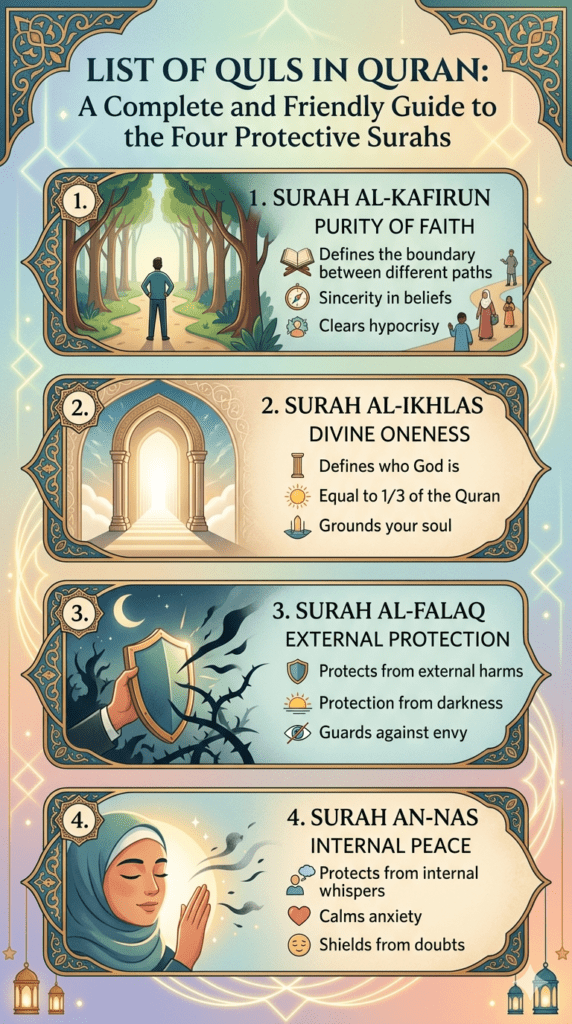
The Quran is filled with verses of immense wisdom, guidance, and spiritual depth. Among its 114 chapters, there is a special group of short but profoundly powerful Surahs that begin with the Arabic word “Qul” — meaning “Say”. These chapters are collectively known as the Quls, and they hold a uniquely important place in the daily life, prayers, and spiritual protection of Muslims around the world. For anyone seeking to understand the list of Quls in the Quran, this guide offers a warm, thorough, and easy-to-follow exploration of each one. What Does “Qul” Mean and Why Does It Matter? The word Qul (قُلْ) is an Arabic command form of the verb meaning “Say” or “Proclaim.” When Allah uses this word at the beginning of a Surah, He is directly commanding the Prophet Muhammad (peace be upon him) — and by extension, every Muslim — to declare, affirm, and proclaim a specific truth or message. This direct command form gives the Qul Surahs their unique energy and authority. Each one carries a declaration of faith, a reaffirmation of Tawheed (the Oneness of God), a rejection of false belief, or a prayer for divine protection. Reciting them is not merely reading words — it is an act of proclaiming one’s belief, trust, and dependence on Allah. How Many Quls Are There in the Quran? A common question among learners of the Quran is exactly how many Quls exist. While many verses throughout the Quran begin with the word Qul, the term “the Quls” in popular Islamic tradition refers specifically to four Surahs that hold special status due to their spiritual significance, their frequent recitation in daily prayers and supplications, and the specific Hadiths (sayings of the Prophet Muhammad) that highlight their importance. These four Quls are: Surah Al-Kafirun (Chapter 109) Surah Al-Ikhlas (Chapter 112) Surah Al-Falaq (Chapter 113) Surah An-Nas (Chapter 114) Some scholars also reference Surah Al-Jinn (Chapter 72) and other chapters that open with Qul, but the four listed above are universally recognized as the Quls in everyday Islamic practice. 1. Surah Al-Kafirun — The Surah of the Disbelievers Overview and Background Surah Al-Kafirun is the 109th chapter of the Quran, consisting of six short verses. It was revealed in Mecca during a time when the Quraysh — the dominant tribe of Mecca — were trying to negotiate a compromise with the Prophet Muhammad (peace be upon him). They proposed that he worship their idols for a year, and in return, they would worship Allah for a year. This Surah was revealed as a definitive, unwavering response to that proposal. The Message of Surah Al-Kafirun The core message of Surah Al-Kafirun is a complete and clear declaration of religious independence. It draws a firm boundary between the belief system of Islam and the practice of idol worship. The Surah does not promote hatred — rather, it proclaims a respectful yet absolute separation of faith. The verse “Lakum deenukum wa liya deen” — meaning “For you is your religion, and for me is my religion” — is one of the most quoted statements of religious coexistence in Islamic tradition. Why Is Surah Al-Kafirun Called the “Bara’ah” (Disavowal)? Islamic scholars often refer to Surah Al-Kafirun as Surah Al-Bara’ah because it represents a clear disavowal of Shirk (associating partners with Allah). The Prophet Muhammad (peace be upon him) reportedly recited it in the first unit (Rakat) of the Sunnah prayer before Fajr and in the Witr prayer, highlighting its foundational spiritual importance. 2. Surah Al-Ikhlas — The Surah of Sincerity and Pure Monotheism Overview and Background Surah Al-Ikhlas is the 112th chapter of the Quran and consists of just four verses. Despite its brevity, it is arguably the most theologically dense Surah in the entire Quran. Its name comes from the Arabic word Ikhlas, meaning sincerity or purity, and the Surah is a pure, distilled statement of Tawheed — the absolute Oneness of Allah. The Message of Surah Al-Ikhlas Surah Al-Ikhlas answers some of the most fundamental questions about the nature of God. It declares: Allah is One — there is no god but Him Allah is As-Samad — the Eternal, the Self-Sufficient, upon whom all depend He does not beget, nor was He begotten — He has no children, no parents, no lineage There is nothing comparable to Him — He is beyond all human understanding or comparison This Surah is a direct response to those who attempted to attribute human characteristics or relationships to God. It stands as the clearest articulation of Islamic monotheism. The Extraordinary Reward for Reciting Surah Al-Ikhlas Among all the Quls, Surah Al-Ikhlas is perhaps the most renowned for the immense reward attached to its recitation. In an authentic Hadith recorded in Sahih Bukhari, the Prophet Muhammad (peace be upon him) stated that reciting Surah Al-Ikhlas is equivalent to reciting one-third of the Quran. This is because the Quran covers three broad themes — stories of the nations, laws and rulings, and the attributes of Allah — and Surah Al-Ikhlas perfectly encapsulates the third theme in its entirety. Muslims are encouraged to recite it after every Fard (obligatory) prayer, before sleeping, and throughout the day to earn ongoing spiritual reward. 3. Surah Al-Falaq — Seeking Refuge in the Lord of Daybreak Overview and Background Surah Al-Falaq is the 113th chapter of the Quran, containing five verses. Together with Surah An-Nas, it forms a pair known as Al-Mu’awwidhatayn — the two Surahs of seeking refuge. These two chapters were revealed together and are almost always recited together, making them inseparable in both religious practice and spiritual meaning. The word Al-Falaq means the daybreak or the splitting of dawn, and the Surah calls on believers to seek protection from Allah — the Lord of that daybreak — from a variety of specific evils. The Message and Protections of Surah Al-Falaq Surah Al-Falaq seeks protection from four specific categories of harm: The evil of what He has created — a general protection from all created things that may cause
How to Learn Quran
Blog

How to Learn Quran: The Ultimate Comprehensive Guide to Mastery

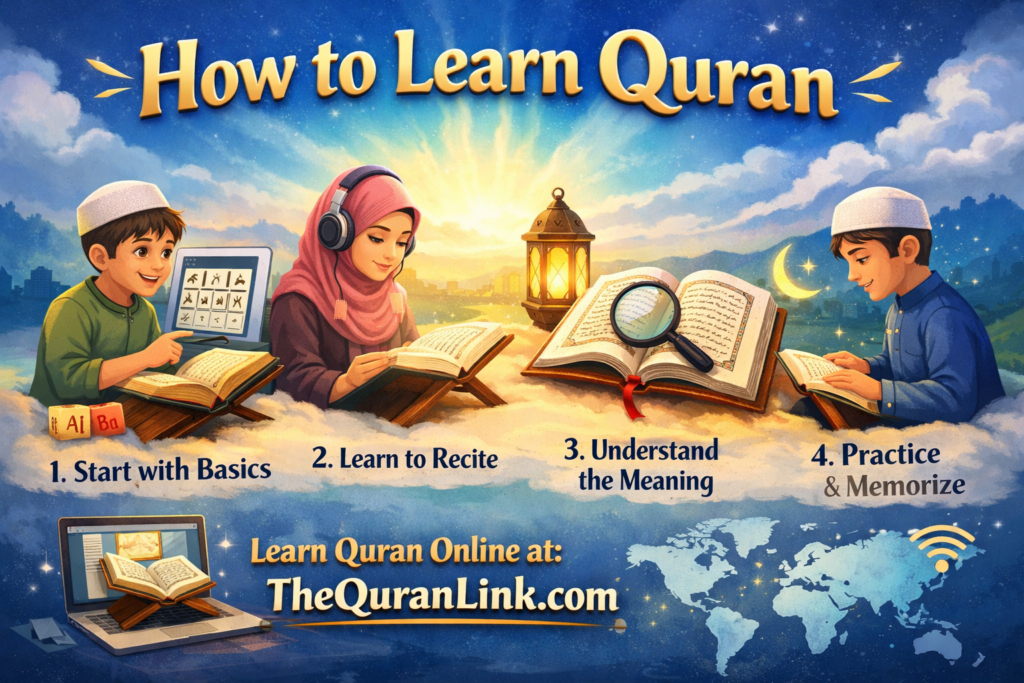
For Muslims around the world, the journey of how to learn Quran is much more than an academic exercise; it is a lifelong spiritual commitment. The Quran is considered the direct word of Allah, and engaging with it provides a compass for moral, social, and spiritual life. However, for many—especially non-Arabic speakers—the question of how to learn Quran can feel overwhelming. This guide is designed to break down that mountain into a series of beautiful, achievable steps. The Spiritual Significance of the Journey Before looking at the technical steps of how to learn Quran, one must understand why this pursuit is so highly regarded. In Islamic tradition, the best of people are those who learn the Quran and teach it to others. When a student discovers how to learn Quran, they are not just learning a language; they are opening a door to divine wisdom. This intention, or Niyyah, is the foundation of the entire process. Phase 1: Building the Foundation You cannot build a house without a solid base, and the same applies when you decide how to learn Quran. 1. Mastering the Arabic Alphabet The very first step in how to learn Quran is becoming familiar with the Arabic script. Arabic is a unique language that is read from right to left and features letters that change shape depending on their position in a word. For a beginner, the most effective way to start is by using the “Noorani Qaida.” This small booklet is the gold standard for anyone beginning the process of how to learn Quran, as it teaches phonetics and letter recognition in a structured way. 2. Pronunciation and Articulation (Makharij) A critical part of how to learn Quran is “Makharij,” which refers to the specific points in the mouth and throat where sounds are produced. Since Arabic has letters that don’t exist in English (like the heavy ‘H’ or the deep ‘Q’), mastering these sounds is essential to avoid changing the meaning of the words. Phase 2: The Art of Tajweed As you progress in your search for how to learn Quran, you will inevitably come across the term “Tajweed.” This refers to the set of rules governing the pronunciation of the Quran during recitation. Why Tajweed is Essential If you are serious about how to learn Quran, you must respect its oral tradition. Tajweed ensures that the reader recites the text with the same rhythm and precision that the Prophet Muhammad (PBUH) did. These rules include: Ghunnah: The nasalization of certain letters. Qalqalah: The “echoing” sound of specific consonants. Mad Rules: Knowing when to stretch a vowel sound for several beats. Learning these rules makes the recitation beautiful and helps the reader connect more deeply with the emotional weight of the verses. Phase 3: Modern Methods and Resources In the past, the only way to figure out how to learn Quran was to attend a local mosque or Madrasa. Today, technology has revolutionized the process. Online Quran Classes One of the most popular answers to how to learn Quran today is through digital platforms. Online Quran classes allow students to connect with qualified teachers from across the globe, often from the comfort of their own homes. This is particularly helpful for: Busy Professionals: Who need flexible timings. Women and Children: Who may prefer the privacy and safety of home learning. Reverts: Who may not have a local community yet to guide them on how to learn Quran. Using Mobile Apps and Software There are now dozens of apps designed specifically to help with the “word-by-word” breakdown of the text. When you are studying how to learn Quran, these apps can provide instant audio feedback, helping you correct your mistakes in real-time. Phase 4: Understanding the Meaning (Tafsir) Many people focus so much on the phonetics of how to learn Quran that they forget the most important part: the message. Bridging the Language Gap While reciting in Arabic is a source of great reward, understanding the “Tafsir” (exegesis) is what truly transforms a person’s life. If you want to know how to learn Quran in a way that impacts your heart, you should keep a reliable translation next to your Mushaf (the physical book). Seeing the context behind the verses makes the learning process much more engaging. Phase 5: Strategies for Memorization (Hifz) For some, the ultimate goal of how to learn Quran is to become a “Hafiz”—one who has committed the entire book to memory. The Power of Repetition If you are wondering how to learn Quran by heart, the secret is consistent, small-scale repetition. Instead of trying to memorize a whole page, focus on one verse. Read it ten times, understand its meaning, and then try to recite it without looking. This “spaced repetition” technique is the most scientifically proven way to ensure long-term retention. Incorporating Verses into Daily Prayer A practical tip on how to learn Quran effectively is to use the new verses you have learned during your five daily prayers (Salah). This acts as a natural review session and keeps the verses fresh in your mind throughout the day. Phase 6: Overcoming Common Challenges It is natural to face hurdles when you start the journey of how to learn Quran. Lack of Time: The best way to handle this is to dedicate just 15 minutes a day. Consistency is more important than duration. Difficulty with Pronunciation: Don’t get discouraged. The Prophet (PBUH) mentioned that those who struggle to recite the Quran with difficulty receive a double reward. Forgetfulness: Memorizing is easy, but keeping it is hard. Constant revision (Daur) is a necessary part of how to learn Quran. Conclusion: A Lifelong Bond Learning how to learn Quran is not a race; it is a walk through a beautiful garden. Whether you are a child starting with the alphabet or an adult seeking deeper meaning, every second spent with the Holy Book is an investment in your soul. By utilizing modern online Quran classes, mastering Tajweed rules, and maintaining a

learn to read quran
Blog

The Path to Spiritual Literacy: A Comprehensive Guide to Learn to Read Quran

A Comprehensive Guide to Learn to Read Quran Understanding a sacred text in its original language provides a level of intimacy and clarity that translations simply cannot replicate. When individuals decide to Learn to Read Quran, they are opening a door to centuries of wisdom and a direct link to divine revelation. This guide explores the multifaceted journey of acquiring this skill, from the very first letter to the beautiful, rhythmic recitation known as Tajweed. 1. The Foundation: Why People Choose to Learn to Read Quran The motivation behind the quest to Learn to Read Quran is often multifaceted. For some, it is about fulfilling a religious obligation; for others, it is about connecting with their identity or finding a source of peace in a hectic world. A Connection Beyond Translation While translations are helpful for understanding the general message, the true miracle of the text lies in its original Arabic eloquence. Those who Learn to Read Quran find that the linguistic nuances, the rhythm of the verses, and the specific choice of words carry a weight and beauty that is often lost in translation. This connection fosters a more profound meditative state during prayer and personal study. The Mental Benefits of Learning a New Script Beyond the spiritual aspect, the cognitive challenge to Learn to Read Quran is significant. Learning the Arabic script—which moves from right to left and features flowing, cursive characters—sharpens the mind. It enhances memory, improves focus, and provides a sense of accomplishment that boosts overall confidence. 2. Starting from the Basics: The Arabic Alphabet The journey to Learn to Read Quran begins with the “Abjad,” or the Arabic alphabet. Unlike the Latin alphabet used in English, Arabic consists of 28 letters, all of which are consonants. The vowels are indicated by separate marks, making the language look like a beautiful piece of art on the page. Recognition of Letter Forms One of the first hurdles for those who Learn to Read Quran is understanding that letters change their shape. Depending on whether a letter appears at the beginning, the middle, or the end of a word, its appearance will shift. This “connective” nature of the script is what gives Quranic writing its flowing, wave-like aesthetic. Mastering Phonetics and Articulation In the early stages, students focus on “Makharij,” which refers to the points of articulation in the throat and mouth. To correctly Learn to Read Quran, one must distinguish between similar-sounding letters that have no direct equivalent in English. For instance, there are different versions of the letter ‘H’ and ‘S’ that require specific tongue placement to produce the correct sound. 3. The Role of the Noorani Qaida For generations, the most trusted method to Learn to Read Quran has been the use of a foundational manual known as the Noorani Qaida. This curriculum is specifically designed to take a complete beginner from zero knowledge to a point where they can confidently navigate the holy text. Step-by-Step Progression The Qaida method is effective because it doesn’t overwhelm the student. It starts with single letters, moves to compound letters, and then introduces the short vowels (Fatha, Kasra, and Damma). By the time a student finishes this manual, they have developed the muscle memory required to Learn to Read Quran without hesitating at every word. Building Confidence Through Repetition Repetition is the secret sauce of the Qaida. By reciting common combinations of letters over and over, the student’s brain begins to recognize patterns. This pattern recognition is a vital skill for anyone who wants to Learn to Read Quran fluently, as it allows the reader to focus on the meaning rather than just decoding the characters. 4. Introducing Tajweed: The Art of Beautiful Recitation Once the basic reading skills are in place, the journey to Learn to Read Quran moves into the realm of “Tajweed.” This term literally means “to make beautiful” or “to do better.” It is the science of reciting the text with the correct pronunciation and rhythm. The Rules of Tajweed Tajweed is not just about aesthetics; it is about preservation. To truly Learn to Read Quran, one must understand rules such as: Ghunnah: The nasal sound produced with certain letters. Qalqalah: The slight “echo” or “vibration” given to specific consonants when they carry a stop sign. Madd: The rules governing the lengthening of vowel sounds for specific durations. The Emotional Impact of Recitation When a reader applies these rules, the recitation takes on a melodic, hauntingly beautiful quality. For those who Learn to Read Quran, reaching this stage is often a highlight of their journey. It transforms the act of reading into an act of worship that can move both the reciter and the listener to tears. 5. Modern Approaches: How to Learn to Read Quran Online In the past, the only way to Learn to Read Quran was to find a local teacher or attend a mosque school. While these traditional methods are still highly valued, the digital age has introduced incredibly flexible alternatives. The Rise of Virtual Tutors Many people today choose to Learn to Read Quran through one-on-one online sessions. This is particularly beneficial for: Busy Professionals: Who can schedule lessons during lunch breaks or late at night. Children in the West: Who may live far from a traditional Islamic center. Women: Who may prefer the convenience and comfort of learning from a female tutor in their own home. Apps and Interactive Software There are now sophisticated applications designed to help users Learn to Read Quran. These apps often include audio recordings of world-famous reciters, allowing students to “listen and repeat.” Some even use voice recognition technology to give the learner instant feedback on their pronunciation. 6. Overcoming Common Challenges No worthwhile journey is without its obstacles. Those who set out to Learn to Read Quran will likely encounter moments of frustration, but these are simply stepping stones to mastery. Managing Time and Consistency The most common excuse for not starting to Learn to Read Quran is a lack of

Scroll to Top